July 7 by Tina S. Zhu

i.

They meet in the summer camp where they are told there’s still time to return to the path to righteousness again, the girl with the knitting needles and the farm girl with the green rain boots. They giggle and listen to each other instead of to the Bible verses about becoming good wives someday to faceless men neither of them want. The instructor tells the girls to be quiet. They ignore her—always a her—because they see the other girls just like them sent here as punishment, and they understand they are not alone. After prayers, the farm girl asks the girl who smuggled in red yarn and knitting needles whether she can make socks for her. Needle girl says she will make the finest socks and finds a tape measure. At her light touch, the farm girl forgets every verse.

ii.

The morning their parents return to drive them back on cornfield-lined roads to homes that are not their homes, the farm girl pulls her boots back on for the mud-slick gravel paths to the parking lot. Before her parents’ truck pulls in and they ask if she’s ready to be a good girl again, needle girl gives her a hat of red yarn, a perfect fit on her head and soft like her cheek against farm girl’s calluses. The two of them promise to stay in contact. But this is how it goes: one email a week becomes one email a month, then two months, then half a year. Needle girl’s family moves to somewhere called the mainland, a land where every word has one of four tones and good girls are called guai yet the word for the strange or the off-kilter is guai with a different tone. Needle girl promises she will return for college, a fancy school with ivy crawling up red bricks that is as far away for the farm girl as the moon.

iii.

Once a year, the woman who was once a girl from a farm flies. She packs a red hat in her fraying suitcase and flies to a town by the sea, Boeing 737 soaring like a metal albatross. Always on July 7th, because she only has enough paid time off to extend her July 4 holiday each year and still have enough days left to visit her parents over the holidays. Every year is the same: farm girl hopes and hopes—they talk and talk over coffee and dinner, shoulders close enough to brush—then needle girl never makes a move. This year needle girl vents about a breakup, a failed relationship with a woman farm girl knows only as a pretty face in the magazines. Needle girl is a somebody, someone who clothes the powerful. Farm girl is a nobody, a nameless paralegal in a nameless law firm in a nameless small town surrounded by cornfields who sends most of her paycheck to keep her parents’ farm afloat amidst crashing crop prices and drought.

Farm girl promises herself this will be the last time. Yet she cannot bring herself to say so, and after needle girl kisses her goodbye and the scent of fake roses lingers on her cheek, she clutches the red hat to her chest at the airport gate, calculating how much to budget for next year’s trip.
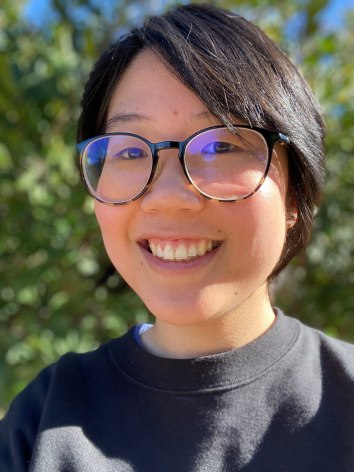

IMG_1193

Tina S. Zhu is a Chinese American writer who lives in California. When she’s not writing prose, she sometimes also writes code. Her words have appeared in Pidgeonholes, X-R-A-Y, and Tor.com, among others. Find her on Twitter @tinaszhu or at tinaszhu.com.

The Collision by Ezra Solway

The car crash happened in a nano second, in a stab of light. For years the boy would describe what had happened as a near-death experience to strangers in run-down piano bars, but the boy knew words wouldn’t do it justice; how they were empty vessels compared to what had happened on that frenzied Philadelphia thoroughfare.

It wasn’t just that the crash had felled acres of neuron-branches across the forest of the boy’s brain, having rattled his skull with vertiginous migraines and permanent memory loss. It wasn’t the uncontrollable rage the boy couldn’t keep a lid on in every serious relationship thereafter. The two divorces, the revolving door of therapists, the weight gain by virtue of his primordial hankering for chocolate milkshakes.

It wasn’t the fact that Ruthie Halpern, the boy’s best friend’s mother and semi-famous jazz pianist, who’d graciously agreed to schlep the boy to his travel soccer practice that morning while his own parents were off hiking Machu Picchu, had momentarily taken her eyes off the road, suffering fractured ribs and broken fingers, thereby shattering Halpern’s career and forcing her to hang up the ivory keys for good.

It wasn’t the fact that the clichéd expression life will flash before your eyes suddenly earned a fresh pelt of meaning as they tooled toward collision, each small triumph and remorse populating out of thin air like a kind of pretzeled mobius strip.

This story really starts now, a generation after the crash. After preschool teacher Madison Dust drummed at her wheel with restless glee, zig zagging lanes to catch her impending flight to Portland. The pregnant daughter in Portland whose water had just burst, and who’d be in labor bearing Madison Dust’s first grandchild. The baby girl who’d soon become her grandmother’s namesake. And later, decades later, the beloved girl who’d grow up wondering about her provenance, snooping through old boxes in the basement to discover the newspaper article with a browning photo of her late grandmother’s fatal crash.

The plume of smoke mushrooming over her grandmother’s totaled carmine-red Toyota Avalon; her flaccid body being lifted onto a stretcher by three first responders; an unidentified boy squeezing her swollen hands, a willowy boy whose mouth was ajar, as though adrenaline had flung him into an exclamation point, as though he’d tried his best to tell the soon-to-be grandmother both hello and goodbye.


Ezra_Solway_Author_photo

Ezra is a poet and journalist who writes in Philadelphia. A Pushcart Prize and Best of the Net nominee, his work has appeared in Philadelphia Stories, Identity Theory, and Bending Genres, among others. You can follow his writings on Twitter @SolwayEzra

Not So Easy Anymore by Tisha Marie Reichle-Aguilera

for Sister and 2020

You’ve been making this trip more than 25 years. Christmas before last, though, it wasn’t like always. You drove out alone despite protests from your kids. Had to reduce risk for aging parents. You didn’t pack a suitcase.

You slowed down at Broadway so you can make the turn onto Easy Street. It’s a gravel road not a real street. The post at the corner says, “not as easy as it used to be.” Now you know this to be true.

As you slowed, the mules trotted over to the fence and stretched their necks to check if you belong. When someone didn’t, the peacocks screeched like a child being tortured with bedtime or bath.

You drove slower. Didn’t wanna dust-out Neighbor’s trailer. He kept the windows open for fresh air even on cold winter nights and sometimes pesticide fumes wafted over on a hot desert breeze, mixed with his breakfast, choked his breath.

After the heavy rains, you knew not to park in the empty lot because the mud would suck the tires off your little city car. You got in trouble when that one boyfriend drove his four-wheel-drive truck across the muddy lot. He left deep tracks and when the sun dried the earth, Daddy had to borrow Mr. Brown’s laser machine to level out that mess. He’d cussed and hollered and that boy wasn’t welcome on Easy Street anymore.

So you parked inside the gate. When strangers did, Freckles would growl a soft warning, her blue-black hackles on end, before she leaped into the air and tried to chew their faces off. She only allowed family and kids with sticky hands. Since she died, Mamá had to lock the doors whenever they went out of town.

You couldn’t stay long. Just a quick gift exchange on the front porch. A bag for Daddy, a box for Mamá, and your handmade ornaments to put on their tree. You saw it through the living room window as you cruised down the road. Framed by poinsettia curtains Mamá had made that matched the ones she’d sent you last year. All the twinkly lights on in the middle of the day. Knew Daddy did that just for you.

No sleeping in the sewing room, giant television watching you, reflecting your tosses and turns. No squishing on the bottom bunk with your husband and youngest who is too tall now. No hip bone wedged in the crack between mattress and wall, face smashed into the wood paneling. No bougainvillea vines scratching the window in a haphazard rhythm. No rooster crowing as you’re about to doze off—it doesn’t know how to tell time. No heavy metal lyrics blasting when Neighbor’s son cruised home after the Horny Toad had kicked him out.

You couldn’t be on Easy Street when the sun came up Christmas Day 2020. Couldn’t turn the couch around to face the tree, open one gift at a time and pose for pictures. Instead, you blew Daddy and Mamá goodbye kisses through your mask and took the kids’ empty Christmas stockings home to fill yourself for the first time ever. You wanted to stay on Easy Street, but you had to go back to your kids and your job, back to undusty roads and different night sounds.


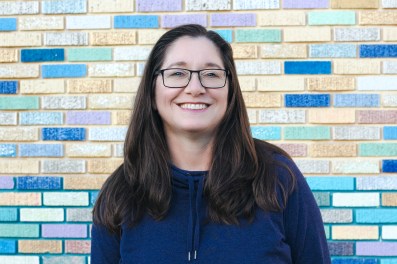
Tisha_Smiling_Golden_WallChicana Feminist and former Rodeo Queen, Tisha Marie Reichle-Aguilera (she/her) writes so the desert landscape of her childhood can be heard as loudly as the urban chaos of her adulthood. She is obsessed with food. A former high school teacher, she earned an MFA at Antioch University Los Angeles and is a PhD candidate at the University of Southern California. Her play Blind Thrust Fault was featured in Center Theater Group Writers’ Workshop Festival. Her flash fiction has been included in Best Small Fictions 2022. Her debut young adult novel, Breaking Pattern, is forthcoming with Inlandia Books. She is a Macondista and works for literary equity through Women Who Submit. You can read her other stories and essays at http://tishareichle.com/

(Photo credit: Rachael Warecki @camerarawphotography)