Look What I Found At The Goodwill by Norma Zimmerman

The dress rack at the Goodwill is packed today. The crimson, sapphire, and emerald prom dresses, sway awkwardly side to side across the gymnasium floor, the smell of roses off her wrist, the hopeful condom in his pocket. The hangers click click as they are pushed down the greasy poles of the rack. Five dusty rose bridesmaid dresses, crinkling organza, a champagne stain on a skirt, slightly slurring, stumbling across the dance floor, all joined together in I’ll never wear this again. A royal velvet evening gown, a slit up the side, bourbon, cigarette smoke, and perfume, holding court at the bar. The silver and black sequined party dress, flashing and winking, wrinkled from the sweaty back seat of a taxi ride. Then the queen, the frosted confection, sweetheart neckline, pearl encrusted bodice, cap sleeves, tulle skirt, smelling like lilies, virginal, pure, as if it had never been worn, a dress left at the altar.


IMG_1408Norma Zimmermann worked for many years as a medical technologist. She is now retired and loves to write flash fiction, prose poetry, and poetry. Her work has appeared in BrightFlash Literary Review and Turtle Way. She lives with her husband of forty-eight years in Massachusetts.
Three Hearts to Love Myself by Elena Zhang

When the ice age strikes, I grow an extra limb, then two, then three. They spring from my body, rows of suckers popping up along their muscular length, wiggling in the air like newborn tongues. My husband stands there in the kitchen and shouts at me, his face turning coral pink, goddammit Beth you stop this nonsense right now, but his words freeze in mid-air, his grubby, creaking fingers snatching fruitlessly at my powerful swirling tentacles. By then, I am already slipping out the door, my new limbs slapping wetly on the pavement, and the last I see of him through the window is his gaping fish mouth as his eyes burst open with ice crystals. Down down down I surge into the ocean, escaping sub-zero temperatures, escaping oxygen, shooting water through the holes in my body like a rocket as I gurgle out salt bubble laughter. I am classified as a dumbo octopus, I can fly, I can fly, I’m soaring. The colder it gets, the faster I propulse. In the dark, I become gelatinous, the purple bruises dotting my skin now just a part of my shimmering chromatophore camouflage, and I live there in the abyss for thousands of years, because down in the midnight zone, you can be soft-bodied and still be a predator.


author_photo (1)

Elena Zhang is a Chinese American writer and mother living in Chicago. Her work can be found in HAD, JAKE, Exposition Review, Your Impossible Voice, and Gone Lawn, among other publications, and has been nominated for Best Microfiction 2024. You can find her on Twitter @ezhang77.

Being microcosms of the whole by Emily O Liu

Being microcosms of the whole, even the individual pieces of me repel light. Hence I play crosswords until I see floaters while a grid of shadows imprints the inside of my lids. My finishing times ricochet like birds move in shifting constellations, swarming blue from the sky. Some days I am brilliant, mostly idiotic. My shadow scares me in the way it morphs, splaying long over dark lawns at dusk, joining me with things I don’t want to touch. I don’t want the constellations to morph but they already are, like how I pull and twist vectors apart in Photoshop. I don’t want to look that strange but I still turn up the brightness on Instagram. I want to be the identical fractals of the wave, not the one riding it. But in real life its certainty is indiscernible. Iterations surge and crash day and night, day and night, and each one splaying over the shore is random at best, at worst, enough to drive me to despair.


eoliu

Emily O Liu is a second-generation Chinese American writer from San Diego, California. A former Fulbrighter teaching English in Taiwan, she is currently studying learning design and technology at Stanford GSE. Her work appears or is forthcoming in No TokensThe Gravity of the ThingHADGone Lawn, and other places.

Fall Equinox by Lucie Bonvalet

In the dunes, the morning of the equinox: a snail, a wet pine stump, a plover. The sunlight
changes. Long blades of grass shine like mirrors. Waves throb. The sun appears, warms
the skin on my forearms and all blades of grass. Waves roll, hidden behind tall dunes.
Waves and plovers together partake in wind and silence. A snail creates a path alone,
through grass, hidden. A wave compresses wind and ocean. Sunlight shifts, shifts again.
Shadows fall in response to the shifts, like a thin rain of darkness on the grass. Clouds
compress, pass, dissolve. The snail does not change their course. The grass undulates, the
pine tree listens. The air, low above the grass, fills up with water. The snail moves in
rhythm with the grass. The pine stump, in the future, will disappear into a wave. The snail
accepts me as a disciple. Sun rays spring up from the mud. Both my body and the dead
tree absorb the rain. Thousands of long sand stems create yellow grass and green silence.
Undulations in light and water. The hidden snail offers me their protection as I have no
shell. Blades of grass open. Wait. Grow. Grow from the middle. Breathe from all sides.
Breathe air, water, and all the colors. Imprint wind, clouds. Absorb mossy rain. Breathe
in sunlight and lengthening shadows.


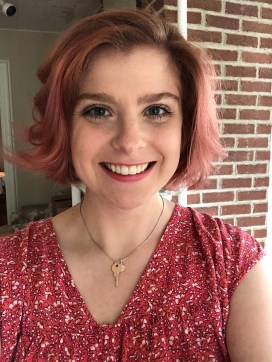
Lucie_Bonvalet_for_Lost_Balloon (1)Lucie Bonvalet is a writer, a visual artist and a teacher. Her writing (prose & poetry) can be found in Catapult, Puerto del Sol, 3AM, Phantom Drift Limited, Michigan Quarterly Review, Fugue, and elsewhere. Her drawings and paintings can be found in Old Pal magazine and on instagram. She received an MFA in Creative Writing from Portland State University in May 2021. Originally from the Dordogne, in the Southwest of France, she lives in Portland, Oregon.
On Retraction by Colette Parris

In a parallel life, I take them back with boundless ingenuity. I use butterfly nets to
capture those drifting balloon-like towards the sun, garage sale vases to scoop up the ones
heading south in the chlorinated pool, a rake to corral the fugitives hiding behind blades of
unmown grass. I fling them all into a lidded box, which I promptly lock with my fingerprint. I
remove the top third of the relevant digit and feed it to the impatient bonfire. The flesh crisps and
blackens in tangerine flames born for this moment. Having Pandora-proofed my receptacle, I
congratulate myself on averting catastrophe. In this life, I have no recourse. The spoken words
imprint with finality, each syllable the weight of a snow-glazed mountain. You walk away. Only
an echo returns.

professional_photo_-_Lost_Balloon (1)
Colette Parris is a Caribbean-American attorney whose poetry and prose can be found in Michigan Quarterly Review, The Offing, Scoundrel Time, MoonPark Review, Cleaver, Lunch Ticket, and elsewhere. Three of her stories have been nominated for a Pushcart Prize. She lives in New York. Read more at coletteparris.com.

After He Talks With God, Abraham Sees His Nephew’s City Consumed by Flames by Abe Mezrich

Sometimes your prayer rises up and turns to smoke. Sometimes a prayer asks too much. Sometimes you offer a prayer for the undeserving but there must be punishment. Even so the smoke continues to rise. It ascends and ascends to heaven. In heaven when they inhale they smell your smoke, your prayer. It reminds them that down on earth, where the fire is, even the wicked can be loved.


Abe_Mezrich_Author_Photo_

Abe Mezrich is the author of three books of poetry on the Hebrew Bible: The House at the Center of the WorldBetween the Mountain and the Land Lies the Lesson, and the forthcoming Words for a Dazzling Firmament, all from Ben Yehuda Press. Learn more at www.AbeMezrich.com.

My Secret Life as a Chain Smoker by Quinn Forlini

When I was six, a man at the corner store force-fed me cigarettes: four in a row that first day, and it was enough. I tried to fight it, pursed my lips and turned my face away as he came at me with the sputtering flame, but my arms were about as thick and breakable as matchsticks. And something clicked with the nicotine, all my organs danced to that sultry song, and my body leaned into the next inhale like a plant bends toward light. Soon I couldn’t stop long enough to brush my teeth. I became a prisoner of my patio at home, where my parents spoke to me through the screen door as I lined up lit cigarettes like disintegrating finger bones. And okay, all that was a dream. But this is true: in 1975, my grandfather got a Marlboro sample pack in the mail. He didn’t smoke, so he gave them to my father, who was eighteen and breathed his first cigarette that afternoon. States away, my mother had started in eighth grade when friends struck a match against the brick in the back of the school, huddled in rain. I’m fascinated by the ease of these beginnings. I, too, crave this small drama, want the tiny violence of something in a back pocket kept ready to burn, to crush with the sole of my shoe. Each cigarette a blank, helpless voodoo doll of myself, my piecemeal insides crinkling like brown tobacco paper. What do I have to blame for what’s broken? I want something inside me to keep catching fire. I want to let my pollution bloom. So when I need another, I triumph. I strangle their throats between my fingers. I murder them one by one.


Headshot_QGF

Quinn Forlini (she/her) has writing published or forthcoming in Catapult, X-R-A-Y, Jellyfish Review, Longleaf Review, and elsewhere. She earned her MFA from the University of Virginia and lives in Lancaster, Pennsylvania.

Smoothing the Cranial Curve of a Ghostskull

Can’t shift this sticky Hoosier summer. No walks off the front porch anymore. My hair won’t behave and it floats like a cloud. My hangnails are drying up and my armpits are wet and the sky is a chalkboard of plane exhaust streaks. Ants nip at my dirty feet and crawl up my dirty jeans and the wind tickles the base-fuzz of my spine. I shaved my toes and still stepped on bees. The house chimes an idle litany. My dead dog’s dishes are asleep in the backyard. I scrambled barefoot over the prickle-grass, trying to find some remnant of her dried shit, but I missed the spring and the softening and now the bluebells by the stoop have turned beige. The basketball on the driveway bakes inside its mud shell. The cars hum down Carlisle. The monarch butterfly I’ve been trying to catch since first grade jitters in the peripheral. I don’t turn to face it. The wind dies. A fly pisses on my arm. A branch cracks by the road. A squirrel sneezes at me and I bark back. He scurries into the tree crown as my hair haloes.


kristinelangleymahler_headshotKristine Langley Mahler is a memoirist experimenting with the truth on the suburban prairie outside Omaha, Nebraska. Author of Curing Season: Artifacts (WVU Press, 2022) and recipient of a 2021 Individual Artist Fellowship from the Nebraska Arts Council, Kristine’s work was named Notable in Best American Essays 2021 and 2019 and is published in DIAGRAM, Ninth Letter, Brevity, and Speculative Nonfiction, among others. She is the director of Split/Lip Press. Find more about her projects at kristinelangleymahler.com or @suburbanprairie.

Epitaph by Kelsi Lindus

We made art. We wept. For no reason. There were tidal patterns in our souls that we could not understand. We had souls, we suspected. We knew very little. We saw colors and we named them. We burned things, yes. We burned everything. We took it all and we used it and we did not feel bad. We turned off the television. We cupped small lifeforms in our hands. It grew warmer. We looked for mushrooms in the dirt. We hosted dinner parties. We drank til we were sad. We never learned. We learned to forgive ourselves and continue. We held the door for a stranger. We were all just babies once. We were all so anxious. We invented occasions to feel warm and generous and sorry. We let the stains set. We put off the important things. We made love. We said love but didn’t mean it. We meant to say it more. We regretted everything and nothing. We were hard, then so soft we couldn’t bear it. We made dramas of our suffering. We could not get out of bed. We humiliated each other. We used our hurt in hurtful ways. We embraced. When it rained, words came to us, and we sat alone and wrote them down. We sang, and the singing broke our hearts, made us kind again, made us better listeners. We were terrible listeners. We were terribly selfish. We built cathedrals and would not let each other in. We were boring. We grew bored. But sometimes we stopped as a bird swooped, plunged its body through the water, reemerged, soared away. We knew to watch. We knew it to be beautiful. We knew.


Lindus_LostBalloon-2

Kelsi Lindus is a writer and documentary filmmaker living in the Puget Sound. Her work has appeared in or is forthcoming from AutofocusX-R-A-Y Literary MagazineCloves Literary, and elsewhere. She can be found online at @kelsijayne or kelsilindus.com.

EUPHORIA=WHEN I HELP THE BODY REMEMBER IT COULD BE MINE by Bojana Stojcic

Every morning I have my usual crise de panique on the way to work—my regular I want
something, and then I don’t, there’s no time (when is the right time), I have nothing to lose, I
have nothing to gain, what if I fail, or even worse, what if I don’t—only this time the fatigue and anxiety drug on well into the day, and it wasn’t until I released that I finally found some relief, which was pretty wow, the way the new mother feels energized by a few hours of sleep, the way she forgets the moist sickness rising up in her throat when the baby pulls on her nipple and her heart beats faster, before hormonal shifts, before exhaustion, before guilt, before the blinds drawn shut, the house forgotten, before pressing her face into her arms, hands digging deep into her flesh like it’s a peach, before pulling the skirt over her head as if to disappear, as if to dissolve into the air and be gone gone gone, before I woke up tired as fuck again the following day, before I was there but elsewhere. In the shower I stayed worried, though I knew if I panicked, I’d feel way better, more myself, so after cell-scrubbing cleansers, after toners, after serums, I put my head between my knees and let it bang in.


pic
Bojana Stojcic, a native of Serbia living in Germany, has work featured in Barren Magazine, Spelk, Okay Donkey, MockingHeart Review, and Versification, amongst other publications. She wishes she could just put her feet up and heave a euphoric sigh of relief.