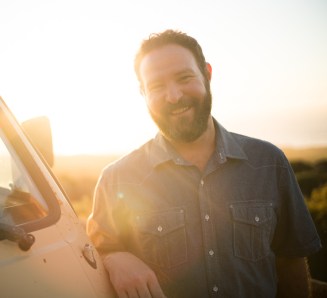
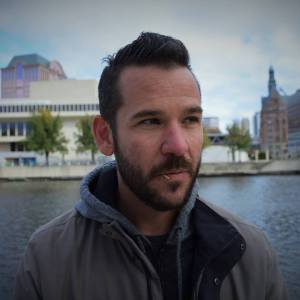
A Matter of Propriety (Paint Rock, Texas) by Jad Josey

The shop doorbell rang, and a thin man with a wiry, unkempt beard dragged the outside heat and dust with him to the counter. I was organizing the cash in the till, rotating and smoothing the bills into neat stacks. His gaze traveled the length of my body, and then he dug into his lower lip with thumb and forefinger and fished out a small lightbulb shiny with saliva.

“I need one like this,” he said. He set the bulb on the wooden counter. It left a mark like a ripe blackberry.

“I don’t think we have any wet ones,” I said.

The man laid his hands on the counter, veins thick and ropy down to his thin wrists. His fingernails were dirty crescent moons. I wanted to flick the bulb off the counter straight at his lower lip. Instead, I banged the register drawer closed with my hip.

I leaned forward and scanned the plastic signs hanging on either side of the main walkway. “Try looking on aisle two,” I said. “You know, where the sign says lightbulbs.”

The man plucked up the bulb and slid it back into his mouth, running his tongue along his teeth to seat it just right. He turned and ambled down the walkway, stopping just before the first aisle to look back at me. “Go on,” I said, nodding toward the back of the store. “I’ve got things to do up here.”

“You got a mouth on you, girl,” the man said.

“Don’t call me girl.”

 As he turned back toward the aisle, Vee stepped out and hit him square in the face with the small wooden bat. It made a hard, wet sound. He staggered back into a metal rack of beef jerky, his jaw hanging loose at the bottom of his face.

“Jesus Christ,” I said.

Vee snorted and pushed a clutch of dark hair off her forehead.

“Your hands are choked up too high, baby,” I said.

She moved her small hands down the bat and stepped into her next swing. The man folded to the linoleum and a corona of blood grew around him. The shop bell dinged, and we both turned toward the sound. An orange tabby stood on its hind legs, front paws pushing against the door. The bell rang again, and the cat squeezed through the thin gap and hopped onto the counter. I opened the till and started emptying the organized bills into my purse.

“Check the bathroom to see if there’s a mop bucket,” I said. “Please.” The cat licked one paw and dragged it over his ear and down his face.

“There’s almost nothing I wouldn’t do for you,” Vee said.

“I aim to find out what that almost nothing is,” I said. Vee smiled and sashayed her hips as she disappeared down the aisle. After she’d gone, I let myself smile back. There are so few people with manners in this world. When you find one, you do whatever it takes to hold on.


_DSC3175
Jad Josey lives on the central coast of California with his wife and three children (and one massive cat). He loved quinoa before it was trendy. His work has appeared or is forthcoming in Glimmer TrainPalooka(b)OINKAtticus ReviewJellyfish Review, and elsewhere. Find him lurking on Twitter at @jadjosey or online at www.jadjosey.com.


Like Dolphins by Noa Sivan

I ran into a family acquaintance on a whale tour. She was wearing binoculars around her neck.

She said: what happened to you? I heard you became a homeless junkie in the city or something, that you’re a prostitute at the side of the road – someone even told me you OD’d.

And I said: yes, it’s all true.

She pouted. Well, you don’t have to be rude, I was just kidding. People your age have no sense of humor. Your parents, they were funny.

We had just left the harbor in Cabo San Lucas. The rules were simple: no swimming, no feeding, no touching. The whales needed space.

She continued. Seriously now, I heard you gave birth to a stillborn and that’s why you went crazy, got addicted to painkillers, stopped eating. And I’m not one to judge, OK? People have stories, even though I was never a junkie person, but you never know, I still have time. She laughed, almost snortled.

I fiddled with my life jacket.

She said: you don’t talk much now, I can tell. You used to smile a lot, remember? You and the Kirshner boy, like dolphins in love. Are you on vacation? With him? She looked around.

There were no whales in sight.

She brushed my shoulder with her fingertips. Well anyway, that’s nice. A bit of sun. You look so pale and skinny. Hey Isaac! Isaac! Come meet someone special! That’s my bar mitzvah boy, the youngest; you’ve never met him, it was after you left town. He wanted to go whale watching for his birthday, and now I meet you here, what a surprise—Isaac, come!

Nobody came.

She rolled her eyes as if a tornado passed through her brain. Well, he’s probably busy watching whales, he’s obsessed with them, wants to be a whale vet – can you imagine that? A Jewish whale vet? I’m not one to judge, but Abe and I hoped he’ll be a bit more—more—Oh my god, here’s a whale!

She cemented the binoculars to her face. You have to see this.

I didn’t turn around. Instead, I went to the other side of the vessel and took off my life jacket. Then I heard a splash. It was a boy. A perfect redhead boy. Floating on his back alongside the whales. Happy.


Noa Sivan was born and raised in Israel and is currently living in Granada, Spain. She is a graphic designer and a writer. Her stories have been published in Jellyfish Review, (b)OINK zine, Ellipsis Magazine, FRiGG, and others.

Avoid Random Spaces by Jonathan Cardew

Timmy T. puked into the toilet bowl and saw carrots. “Huh,” he said, pushing his fingers through his hair. He never ate carrots. Never once.

In the bar, Maude was ready to kill him or kiss him. “You’re a twat,” she said. “A complete and utter…” 

She pulled him up close by the scruff of his Lacoste. “Go.”

Timmy T. went, lifting a finger. Funny, because Timmy T. adored Maude.

That night was a big kebab. Oily. With uncalled for hard bits. The hard bits you pull from your teeth.

Timmy T. loved the smell of exhaust fumes. He loved the way it made him feel: lightheaded and queasy. He loved Maude more than anything, but he loved fucking cars, too, which was the roadblock.

 “You fuck another car, Timmy T….”

 He did. He fucked another one. A Volkswagen Beetle, the new kind. Pulled down his pants and put his dick in the exhaust pipe. Kneeled because the pipe was so low.

The night was a big, wet, sloppy portion of curry with chips. It was the carrots in the puke, slimy and orange. Painted onto the sky, under his eyelids. He loved Maude. He loved the slight heat of the pipe. He loved the rocking of the car frame, the give of the wheels, the way Maude used to flick her nails on the soft skin between his balls and bum hole.

He would grasp the car lights and rest his face on the rear window.

Sexual intercourse.

 Timmy T. stomped back to the bar.

Maude was sucking a toothpick. She had a Mai Tai and a bag of crisps, spilled on the bar. She had half-crossed eyes, and knees so skinny and shiny, it broke his heart all over.

“Avoid random spaces,” she said, looking at his left ear or beyond his left ear, concentrating.

Everything about her was concentrating.

“What do you mean?” said Timmy T., sliding in next to her.

He was thankful, therefore his question was soft.

“You heard me,” said Maude.


Headshot_Jonathan CardewJonathan Cardew’s writing appears or is forthcoming in Passages North, Superstition
Review, JMWW, Smokelong Quarterly, People Holding, 
and Atticus Review, among others. He’s the fiction editor for Connotation Press, contributing books reviewer for Flash: The International Short-Short Story Magazine, and interviews editor for (b)OINK. He’s been a finalist in the Best Small Fictions, the Wigleaf Top 50, the Bath Flash Fiction Award, and he won a travel toothbrush once at a boules competition in northern Brittany. Originally from the UK, he lives in Milwaukee, Wisconsin.

Half a Minute by Rachael Warecki

His body was especially beautiful naked: lean, hard curves of muscle along his shoulders, the taut slope of his back, sprawled limbs across tangled sheets. She studied the way the squares of light from her bedroom window illuminated the red undertones of his hair. He was perfect, even with his neck broken.

She hadn’t meant to. Hadn’t known she was capable of it, even on accident. But she also hadn’t realized, until an hour ago, that she really was the woman of her husband’s accusations, the kind of woman who’d let her new neighbor corner her into bed. She’d spotted him across the dim-bulbed hallway, pushing a bookshelf through his front doorway, and let him catch her eye. Thinking: her husband would notice the neighbor soon enough, would build his own theories around the square of the man’s jaw and the quickness of his smile, and would take his jealousy out on her, using his imagination as evidence and his hands as judge and jury. It wouldn’t hurt her any worse to look a little. To admire the newcomer as he crossed the hall and leaned against her doorframe. To let him breathe flirtations in her ear. Gentle. Different.

But then he’d put his weight behind that old expression, being forward, each kiss a nudge in the bedroom’s direction, her retreating half-steps as small as she could make them, staying faithful until she’d felt the mattress hit the backs of her thighs. She imagined how it had looked from above: the knight’s angled pursuit, the queen’s slow gambit through the grid of the apartment, allowing herself to topple. Afterward, after they’d climbed back out of bed, she’d twisted her ring around her finger—a thin, cheap band, easy to miss except when it was the only adornment on her body—and felt the alarm hammer of her heart clanging at the edges of her rib cage. She’d lied to herself, let things go too far. She’d told him he had to leave. Now, she’d told him, and kept twisting that wedding band. He’d lunged at her. Not so different, after all, from the men she’d spent a lifetime loving and hating in turn.

She hadn’t flinched or cowered, the way she did with her husband. As if, after so many years, her body had lost the capacity to move backward and forward. Instead, diagonal: a sidestep, her fingers gripping his hair and his temples pulsing between her palms and the heels of her hands against the edges of his eye sockets, and then a desperate, twisting motion as she’d flung him toward the bed, away from her. The crack as his skull collided with the headboard at the wrong angle. The odd, painful L-shape of his neck. And now she leaned against the nightstand, her body as naked as his, though far less beautiful, her hands clasped behind her back, no longer trustworthy.

She heard, too soon, the front door open and shut. Heard the jangle of her husband’s keys as he tossed them into the dish. Heard his whistle—jaunty, quick-tempoed—and knew how quickly those notes would sour as soon as he bulled his way into the bedroom.

Her hands found the nightstand drawer, opened it, fumbled until they grasped the scissors she kept there. The window’s light dappled across the bedsheets. In the other room, her husband’s movements were as slow and deliberate as a king’s: one step at a time, in any direction. He paused, called her name. Started whistling again, took a step toward the bedroom. Thirty more seconds before his tune would change. Half a minute. She clenched the angled blades against her spine and waited.


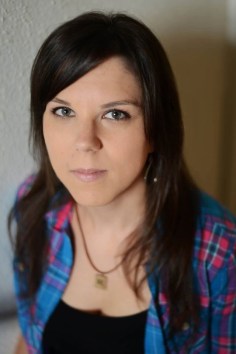
img_5440

Rachael Warecki’s fiction has previously appeared in The Los Angeles Review, The Masters Review, Midwestern Gothic, Tahoma Literary Review, and elsewhere, and she received a 2014 Best of the Net nomination for flash fiction. She holds an MFA in Fiction from Antioch University Los Angeles, has previously attended the Tin House Writers Workshop, and was selected as a 2017 Emerging Voices Fellow at the Wellstone Center. She is currently (perpetually) at work on a novel. More information is available on her website.

Things We Stole by Kristin Bonilla

His voice went sing-song when he threatened me. “Don’t you mess with those horses, now. Those horses are wild. They’ll stomp you into jelly.” He was on the porch and I was in the yard, squatting in the hot dirt. His whiskey smelled like burnt wood, so I scuttled back underneath the house through the crawl space.

I wasn’t messing with the horses. Never did. I was prospecting, my knees bent for hours underneath the groaning floorboards of the house we lived in that summer. Below the house was sand and buried in the sand was gold. Gemstones. Precious things buried long ago by someone who needed to hide her jewels. I knew what it was like to hide.

I used a pie tin poked through with holes to sift the sand and find the treasure. Bracelets, necklaces, brooches, rings. Each new trinket I would spit-shine, rubbing my dirty fingers in circles over each gritty piece until I could judge what I had. Some of it was plastic. Some of it wasn’t. I hid all of it, stuffed in my pockets so that he wouldn’t see, so no one could see.

I imagined where the jewelry had come from. From a belle, newly married. She could hear the drumming of the march, the beat of disciplined bootsteps. The sound of men approaching. It was just her there, her husband off fighting the war. She knew there would be gunshots, fire. Worse. She ran into the yard while it was still dark and buried her jewels, hoping she’d make it back for them but she never did.

Sometimes girls disappear.

Back out in the sun, I turned away from the empty porch and surveyed my haul. Black beads, plastic. A necklace, silver with a reddish gemstone. Carnelian, the color of dried blood.

I wasn’t doing anything bad when the horses jumped their fence. It wasn’t my fault they were wild, that their splintered fence needed patching, that they could easily escape into our yard lined with apricot trees. The air was sick with fruit, heavy with sweet.

I heard them before I saw them, two dozen hooves pounding on the sandy soil, a rumbling train coming up behind me. And then they were there, around me, and it was calm again. There was a mockingbird drilling, the shimmying of leaves in the breeze. The horses nickered and swished their tails as they pulled the apricots off the snapping branches.

It felt like magic. Like a blessing. Why shouldn’t they eat the fruit? Why shouldn’t they flee the men who meant to break them?

He was already coming down the steps when I heard him.

“Don’t you move,” he said. He looked at the horses and he looked at me. He stopped on the bottom step and crossed his arms. “What have you got in your pockets?”


FullSizeRender-2

Kristin Bonilla’s fiction appears in Cleaver Magazine, NPR: Three Minute Fiction, NANO Fiction, Smokelong Quarterly, online at Gulf Coast, and elsewhere. She’s an associate flash fiction editor at jmww. Read more at http://www.kristinbonilla.com and @kbonilla.

Triangle by Fiona J. Mackintosh

Even in the womb, Mother said, Giula and I twined round each other like fish in a barrel. Born just thirteen minutes apart, we slept heart to heart in the same bed, warming our feet between each other’s calves. 
 
Her face was mine, except for the scar above her eyebrow from when she fell on the fender as a baby. We wore our hair in the same long braid so no-one on the Bowery knew which of us was which. 
 
Everything we did, we did together. Dripping hot candle wax on our fingertips to harden them for the sacks full of garments Mrs Leventhal brought every day. Scratching our names with a pin on the side of the mantel when no one was looking. Sent out to the fire escape to peel potatoes, we’d drop the eyes onto the horses’ heads and talk about who we’d marry, craning to stare at the Russian boys with the wide black hats and long dark curls down their faces. 
 
Whatever happened, on the street, in the family, we knew it all. We knew Mother was done after having Santino, Rosetta, and Angelo in five years. When Papa came home from building mansions on the Upper East Side, she’d turn her back as he washed his bare chest in a basin by the stove. Sometimes he’d go out late and not come back all night. We were sure he had another family over by the bridge, till we saw him coming out of Ma Rozzoli’s whorehouse. When he’d scratch himself through his breeches, we’d bend our heads over our sewing, red-faced with hidden laughter.  
 
Nothing ever came between Giulia and me till Vicenzo Romano. Vic. Yellow-haired, green-eyed, full red lips. He was the stock boy at Benedetti’s Delicatessen where I worked behind the counter. Behind the towering wheels of parmesan, he kissed me, his mouth dusty with the peanuts he liked to chew, splitting them at the seam with his thumbnail.
 
Giulia was working in a loft shop up near Washington Square Park. On my days off, I waited for her under the sooty trees, pigeons pecking round the toes of my boots. Sometimes Vic came with me and he’d walk us both home. When Ma invited him for supper, I saw Giulia bend to smell his hair as she took his plate. That night under the quilt she asked, “Do you love him, Fina?” but I turned away blushing in the dark. 
 
When Vic bought me a red velvet ribbon, we were as good as engaged. We’d roam the streets at dusk, stopping to kiss just beyond the light cast by store windows. Giulia went about with her friends from the factory. I’d leave the lamp burning for her and wake as she slipped into bed and turned her back to mine.  
 
One night when she came home, I waited up and gave her my ribbon. I knew how much she’d wanted it, how she’d touched the velvet with one wary finger when she thought I didn’t see. She took it without a word. When I woke the next morning, she’d already left for work, leaving it coiled loosely on the dresser, a splash of flame in the dim brown room. Leaving it for me. Running the soft velvet between thumb and finger, I made two loops of it and tied them in a bow.  
 
Later, Vic and I walked to meet Giulia from her shift, weaving through the almost evening crowd, dodging the soft green turds dropped by the dray horses, breathing the vegetable stink of the gutter. As we strolled the pathways of the park, March rawness made me clutch Vic’s arm close. A clatter of heels and a woman ran by us, then a patrolman wheeled his horse towards thick black smoke pulsing across the skyline. From the building where Giulia worked.
 
High above us, faces crowded the blazing windows, mouths open. Fire horses skittered, eyes white, a hose slithered across the asphalt and a ladder cranked up and up, with a great groaning, then stopped – “Too short!” – and women wailed and screamed and covered their eyes. Girls clinging to window frames launched like a flock of birds, raining down on the asphalt in a drumroll of moist thuds. 
 
A girl balanced on a sill, up on her toes. Even from afar, I saw the red circle round her neck. Arms raised high, muscles of fire arcing from her shoulders, she leaned gently forward and fell, sparks cartwheeling from the ends of her hair.   
 
Wrenching myself from Vic’s grasp, I ran, seeing nothing, hearing nothing but Vic behind me calling “Fina!” Up the tenement stairs, past women leaping to their feet in an avalanche of cloth, I raced to our cold dark bedroom, snatched the ribbon from the dresser and fell to my knees.  “It wasn’t her, it wasn’t her!”
 
But when I turned to look at Vic, when I saw his mouth twitch and his eyes dart, I knew that Giulia had her own ribbon, as red as mine and just as soft between the fingers.   
 
I’m 90 years old now and the people here are very kind. They move the mirror with me from the chair to the bed and back. They know I like to talk to Giulia. It’s like it always was for us, there’s no one else we need. I no longer see her scar. It’s sunk into the fretwork of our ancient face, those lines I trace all day and night, my finger on the cold unyielding glass. 

Fiona Mackintosh
Fiona J. Mackintosh is a British-American writer who has been widely published in both countries. Her stories have been shortlisted for the 2016 Exeter Story Prize and longlisted for Plymouth University’s 2015 Short Fiction Prize, the 2016 Bristol Short Story Prize, and the 2017 Galley Beggar Short Story Prize, and her flash fictions have been published most recently in Spelk, the Nottingham Review, and the Bath Flash Fiction Anthology. She is a proud recipient of a 2016 Maryland State Arts Council Individual Artist’s Award.

SaveSave

Tiny Hands by Daniel W. Thompson

It’s true what she said, my wife, she said I have tiny hands. She tells me this while we are out to dinner for our anniversary. I pull my hand back from hers. We’d been holding hands across the table where the candle light turned everything to shadows. Except my hands. They glowed. I stick them under the table behind the long white cloth.

Not a real popular time to have tiny hands, I say.

No, no, she says. She didn’t mean anything bad by it. It was a light-hearted joke. And by the way, as far as she was concerned, that asshole doesn’t have the confidence to overcome his differences. You’re better than that, she says.

My own hands come to a point, paring down like a traffic cone. The boys on the basketball team used to joke how I couldn’t palm the ball.

But in bed, you know, I’m more than adequate, right, I ask my wife. She smiles from across the table. Oh my, of course you are sweetie, the best I’ve ever had, she says.

Then again, she is my wife, my for better or worse.

When I shake another man’s hand, I think firm but not aggressive. Let him know I’m worthy. So often I short the handshake and the larger hands swallow my small offering. I’ve lost right then. Oh, think of the disregard a man with tiny hands receives. They say, he’s not the one to deal with, he lacks the proper fortitude. Bigger is better, bigger is better, would you look at the size of his-

I have big feet, those I have, but nobody worries about feet. Feet have never made an impression. You don’t hold feet in the candlelight.

Are you okay, my wife asks. I think your hands are beautiful.

Right then, the waiter, a giant man-child with baseball mitts for hands, brings us steaming red lobsters. Would you like me to crack them for you, the man-child asks.

No, I yell. Do you think I can’t crack my own lobster?

He’s a little tired, my wife tells him. It’s fine, really, we’ll be fine, thank you, she says.

I pay the check and it’s everything I have to not stiff the man-child. I know his fortune is not his fault.

In the car I can tell my wife feels bad about her comment. She puts her hand on my thigh but I leave mine where they are. She has finally cut me open.

I swear it was a joke, sweetie. You have to know that, she says as we pull into our driveway.

The babysitter peaks out the window.

Can I make it up to you, my wife asks.

We pay the babysitter and go upstairs to make love. The entire time I am on my back, hands to the sides, watching a bottle of nail polish on top of her dresser. My wife’s eyes are closed until she finishes and then she opens them to look at me like it’s the first time she’s met me. I know there’s no way she’s thinking of me when she’s up there.

That-was-amazing, she says as she rolls over. No man in this world can do that, sweetie.

She leans over and kisses me on the cheek. Happy anniversary, she says.

Hey, I say to her.

Yes?

Never mind.

After she has fallen to sleep I get out of bed and walk over to her dresser. Rose, extra glossy. That’s what the nail polish says. I pick it up.

Downstairs in the kitchen I paint my toenails under the light of the stove. I’ve watched my wife do it to our daughter enough times to know I should go easy with the application but I lay it on thick. Polish is running over the sides of my long toes.

After I finish, I go outside onto our back deck. The moon is full and everything is either blue or white, except my toes. They’re on fire, and because of it, I decide I’m going to wear only flip flops from now on. That way everyone can stop staring at my pointy, feathery, god forsaken hands and look down to where I am all man, thinking what they may of my rose colored, extra glossy nails.


Photo of Daniel W. Thompson

Daniel W. Thompson’s work has appeared in publications like decomP, WhiskeyPaper, Wyvern Lit, Third Point Press and Cheap Pop. He works as a city planner and lives in downtown Richmond, VA, with his wife and children.

The World’s More Full of Weeping Than You Can Understand by Lori Sambol-Brody

When my sister returns after seven days missing, she tells us the faeries stole her. Oona ate seven mushrooms at their feast and a faerie knight commanded her to ride with them for seven days. She says, He set me before him on a stallion. They ride bareback, you know. She grins. Cherries stain her teeth like blood. You become the favorite child if you go missing; my mother feeds her fruit out of season and lets her paint her nails black. Oona tells me, I had never felt more protected; I had never felt more afraid. She promises to make me a love charm she learned from her knight so Julian will kiss me behind the ears. But at a cost she doesn’t name: there is always a cost. She tells me, I had never felt more loved; I had never felt more hated. I wonder if the faeries returned a changeling instead of my sister. I pretend to brew coffee in eggshells, but she doesn’t laugh, just rolls her eyes. I spy on her after she takes a shower. Through steamy air I see her rub a salve smelling of night flowers on the green and yellow bruises marring her thighs, her arms. When we watch Pretty Little Liars, she cocks her head, says, Can’t you hear the faerie music? In the flickering underwater light of the television screen, she dances. Her arms sinuous, her hips gyrating. I don’t hear anything no matter how hard I strain. Wondering why they chose her over me.


LoriLori Sambol Brody lives in the mountains of Southern California.  Her short fiction has
been published in Tin House Flash Fridays, New Orleans Review, The Rumpus, Little Fiction, Necessary Fiction, Sundog Lit, and elsewhere. She can be found on Twitter at @LoriSambolBrody and her website is lorisambolbrody.wordpress.com.

Alone and Not Alone by Kate Gehan

At the club, Clarissa listens to the Dirty Dancing soundtrack on her Walkman and experiments with sitting in different positions to watch her flesh ooze through the lounge chair’s plastic strips. She flips onto her stomach and lets her head drop until her braid, thick as rope, swings down to touch the grass. Beneath the chair, her stomach and thighs squeeze through the open slats, gravity an unflattering force. Nothing could be more difficult than being the age she is now.

Jonathan walks by and snaps her back with the tip of a wet towel. It stings. His teeth remind her of yellowing shells but his wet swim trunks cling to his muscles nicely. All summer he has been teaching her how to dive after swim team practice.

“Watch this,” Jonathan says as he climbs the pool high dive. He positions his toes along the edge of the aqua board.

“Flip!” Clarissa yells.

“Show us how it’s done, Merman!” Jonathan’s friends scream from the water.

He nods, bounces a few times, and vaults high enough for two summersaults before entering the water. Everyone knows he’ll go to a big school in Florida on a diving scholarship if his grades aren’t good enough for an Ivy.

***

Before he jumps, Jonathan curls his toes across the tip of the diving board and forces quick, hyper, breaths until he is nearly dizzy. As he bounces, he takes a few of the longest breaths he can to clear out his lungs. He ignores his friends’ taunts from below. If he holds enough air in his lungs this time, he may go deeper than ever before. Jonathan takes one final gasp, launches himself into a tuck, and after a few spins, he descends.

Once he cuts through the surface, he opens his eyes to the shallow water’s burning chemicals and sunlight. He pulls himself away from it, and his nose tickles with an emerging coldness. Deeper into the darkness, away from rules. This longing to swim like a water creature is a petulant exercise, because of course Jonathan lacks the gills and the webbing. The water changes, becomes murky. A seahorse floats past, up towards the cheery surface.

His organs compress. He reaches a place of depth where paddling is no longer required and he begins to fall like a stone without moving his arms or kicking at all. Teaching his body to do this is important during the planet’s current stage, when communion with the water is still a pleasurable pastime and there is just enough dry land. Jonathan knows this stage will not last forever.

His body desires oxygen at the mitochondrial level and the mighty pressure of the water begins to wipe his thoughts clean. How many minutes has it been? It definitely seems longer than the last dive. Years have maybe passed when he hears singing in the distance—less song than vibration, not something communicated through his mollusk ears. Gargantuan mammals sense life from miles away. Perhaps they feel him in the water now, sinking down to the place where they feed from grasses, and they will welcome him. Jonathan is but a dollop of life in this place and the blackness drenches him now, seeps through his skin in a somnambulistic erasure.

Fingers and toes numb, he convulses involuntarily and instinctively turns his body around before it’s too late. Furiously reversing all of his effort, Jonathan follows the upward direction of the bubbles.

After what seems like another set of years, he wheezes at the glorious surface, beneath the diving board. His friends beckon him to play their stealth attack army game of pretend-drowning in the shallow end of the pool. Jonathan swims over to them, still transfixed by the inevitability of a time ruled by scarcities in a world where nearly everything is afloat. He is not frightened because he is learning the mysteries. The next day, and the day afterwards, his diving will improve and he will decode the songs of the deep.

***

Clarissa claps for Jonathan when he emerges, but he’s too far away to hear, swimming perfect strokes over to the boys pretending to be Navy Seals choking one another. The lifeguard blows her whistle on the shenanigans.

Swim practice begins in an hour and Clarissa decides to head over to the club snack shack for lunch. This summer she has stopped eating French fries with her sandwiches because most of the girls on the team have pancake-flat stomachs, some concave even. She wants to winnow herself into a sharp blade. She imagines executing a dive alongside Jonathan where they slice the water together, perfectly synchronized.

Clarissa sucks in her stomach and almost succeeds in disappearing her little roll of belly fat as she walks by Jonathan and the boys horsing around. Jonathan expertly flicks water at her leg and says something about her “fantastic breath control.” Because her Walkman headphones are in her ears Clarissa pretends she can’t hear, but she holds her breath as long as she can, until the fir trees along the snack shack pathway are blurry and her thoughts become microscopic objects just out of reach, floating off to some larger sea.


KGehan

Katherine Gehan’s writing has appeared in McSweeny’s Internet Tendency, Literary MamaThe Stockholm Review, Sundog Lit, Split Lip Magazine, People Holding, Whiskey Paper, (b)OINK, and others. She is nonfiction editor at Pithead Chapel. Find her work at www.kategehan.wordpress.com and say hello @StateofKate.

How I Learned My Name by Sandhya Acharya

The kids in my kindergarten class would already be on the second page of their assignments while I was still remembering the letters to my name, Gobind Lambodhar Banerjee, which contained half the stinking alphabet. In third grade, I insisted people call me Gollum.

Overnight, from a freak, I became the cool kid. It was a bit strange at first. The scrawny brown boy in a class full of white kids being called Gollum seemed a bit offensive. But it gave me an identity, made me stand out. I walked around calling girls “my precious”  and they didn’t even mind. They giggled and locked hands with me. Gollum had struck gold.

My mother she still called me Gobind. She stressed each letter and ended the D emphatically. Sometimes she’d add an “O” and call me Gobindo. The “O” would trail on the air like the lingering scent of a skunk.

One day my friend Sara called and asked to speak to Gollum. Confused, Ma explained to Sara what my real name meant; ”Gobind or Govind like the the God Krishna. The blue one, you see.” I cringed. Did she really say that? I felt flushed, more red than blue. Sara laughed when I took the phone. She teased, “Gollum, are you a God?” I didn’t eat the lunch Ma sent to school for days. She made fish curry, samosas, even Mishti Doi one day. Staying away from Mishti Doi, that creamy, milky, sweet concoction, was hard. But I did. Food was a powerful tool, and I used it against her by rejecting what she made.

After I began middle school, she stopped packing my lunch three days a week. Instead, she slipped a few dollars into my hands and said, “Go have fun! Eat what you want.” It was liberating. I got ready by myself in the mornings while she made her tea, pounding the ginger and cardamom patiently. She would stand by the door, steaming cup in hand, stealing glances of me while I put on my shoes. In the evenings, two days a week, she drove me to piano lessons. She made me go, no matter how many jarring, off-key notes I played.

When I turned sixteen, I could drive myself to classes and back in our old red Corolla. I managed my own schedule—friends, library, school. I was on top. Though I’d given up piano by then, I excelled at debate and swimming. I would have no problem in getting into the college of my choice.

I didn’t see Ma much on weekday evenings then. She said she’d joined the gym. But when I studied at night, her light in the bedroom stayed on. When I came out to go to the bathroom and get ready for bed, she’d walk into the kitchen for a glass of water and to ask if I needed anything. Once, when I came back late at night from my swim meet in another city, I saw her peep down from the window. I groaned and braced myself for the questions, but when I walked in, I didn’t see her anywhere. Just a plate on the table with my dinner. It was then I realized I wouldn’t have minded her sitting across from me, asking how my day was.

A few weeks after that lonely night came my graduation. The phone rang while Mother got ready upstairs. My old friend Sara called to see if I was ready. I was supposed to ride with her. I apologized, and said things had changed, and that I’d see her at school. I bounded up the stairs and found Ma. She looked beautiful in pink tussar Sari.

“I’m ready to go if you are,” I said. As she looked at me surprised, I asked, “Can I drive?” She hugged me and patted me on the back. Before we left, she lit a lamp in front of the deities and  dragged me to the kitchen. She pulled out a little pot stored in a corner of the refrigerator and handed me freshly made Mishti Doi, which I promptly ate. The sweetness stayed in my mouth the entire two miles to the school. She held my hand while on the road for a brief moment and then mumbled “sorry” before breaking into a sheepish smile. That smile passed away too fast.

The auditorium was full by the time we arrived, so I ran to join my friends. Ma found her seat. Dozens of parents sat proud and beaming, ready to cheer their children. From the stage, Ma’s pink Sari stood out in the crowd.

The roster set on the podium, and the announcer Mr. Ross was about to start. I ran to him. He nodded, scratching and rewriting on his paper. When it was my turn to do the walk, my friends looked around surprised when they didn’t hear the familiar Gollum. Mr. Ross instead, very adeptly pronounced the words Gobind Lambodhar Banerjee. I heard Ma clapping loud from her row. I could see her tearing up as she mouthed the words, “my Gobind.” I grinned, waved her a kiss, and murmured “my precious.”


IMG_2938
Sandhya Acharya grew up in Mumbai, India and now lives in the Bay Area. She worked as a financial professional and loves to dance, run, and be Mom to her young sons. Her articles have been featured on NPR (KQED), and in India Currents and IMC connect. She blogs at www.sandhyaacharya.com.

SaveSave

SaveSave