Before she knew Pollock, she was Lena. Lena changed her name to Lenore, then shortened it to Lee. Lee Krasner. Do you want to know what Lena-Lenore-Lee looked like? Why?
When her sister died, Lee didn’t marry her brother-in-law, to become a mother to Rose’s motherless two. She didn’t compromise her adolescence with a ring or end her story with a mop and pail. She set up her easel and painted. She painted herself—steady-handed, steady-eyed, by the woods’ fitful light. There was art school, then a Russian lover, her work, always the work, avant-garde, cubism, abstraction. And there were connections. Pollock was one. She called his paintings “wild enthusiasm.” This artist she loved.
Do you want to know more about the man she married? The painter she nurtured? You’ll have to read something else then. I’m not saying Jackson Pollock wasn’t good, but I’ll tell you this: After the painters bought a house, Jackson turned the barn into his studio and used the expansive floor as an easel, so he could stand over the supine canvas and create from a towering angle. Meanwhile, Lee composed inside the house—small pieces crafted in a small bedroom. She even gave them a small name: Little Image. In this series of thirty-one paintings, she covered the canvases in grids of diminutive blocks, individual containers for vitality, squiggles, signs, swirls, like hieroglyphs, those symbols that line a tomb. An enclosed language, yet untranslatable, unheard. Enclosed. Yes, entombed.
Still want to know what she looked like? She looked like genius, eclipsed.
But then, of course, the husband eclipsed his own genius. Addiction, attention, infidelity, attention, anger, attention, unpredictability. He didn’t paint at all the last year of his life.
Lee did. Before Pollock, she painted. After Pollock, she painted. For the thirty post-Pollock years, Lee kept working, experimenting, growing. If there was chaos, it wasn’t splattered. She controlled it.
Some of her paintings came from old pieces she tore up and reassembled. She called one of these collages Milkweed: black pieces like detached petals, overlaid with spears, elegant and white, and a backdrop of greens suggesting vegetation. A broken sphere centers the piece, like a sun tucked into a forest. But my favorite aspect of this work is the streak of orange. It cuts a vertical path. Such a dynamic swath of color. It surprises. I think it must be a Monarch taking flight.
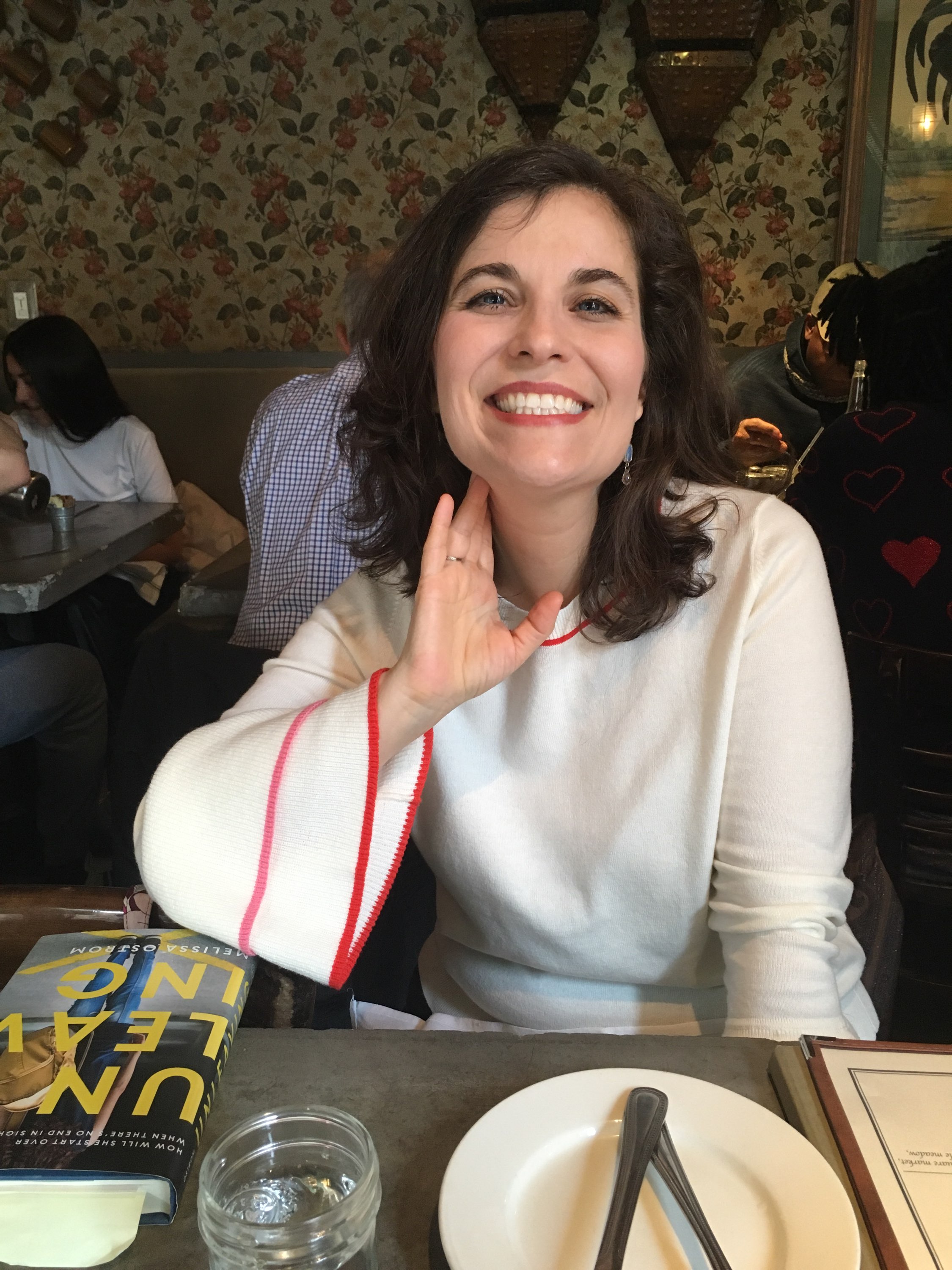
Melissa Ostrom is the author of The Beloved Wild (Feiwel & Friends, 2018), a Junior Library Guild book and an Amelia Bloomer Award selection, and Unleaving (Feiwel & Friends, 2019). Her stories have appeared in many journals and been selected for Best Small Fictions 2019 and 2021, Best Microfiction 2020 and 2021, and Wigleaf Top 50 2022. She lives with her husband, children, and dog Mocha in Holley, New York. Learn more at www.melissaostrom.com or find her on Twitter or Bluesky @melostrom.
 Lost Balloon