Krasner by Melissa Ostrom

Before she knew Pollock, she was Lena. Lena changed her name to Lenore, then shortened it to Lee. Lee Krasner. Do you want to know what Lena-Lenore-Lee looked like? Why?

When her sister died, Lee didn’t marry her brother-in-law, to become a mother to Rose’s motherless two. She didn’t compromise her adolescence with a ring or end her story with a mop and pail. She set up her easel and painted. She painted herself—steady-handed, steady-eyed, by the woods’ fitful light. There was art school, then a Russian lover, her work, always the work, avant-garde, cubism, abstraction. And there were connections. Pollock was one. She called his paintings “wild enthusiasm.” This artist she loved.

Do you want to know more about the man she married? The painter she nurtured? You’ll have to read something else then. I’m not saying Jackson Pollock wasn’t good, but I’ll tell you this: After the painters bought a house, Jackson turned the barn into his studio and used the expansive floor as an easel, so he could stand over the supine canvas and create from a towering angle. Meanwhile, Lee composed inside the house—small pieces crafted in a small bedroom. She even gave them a small name: Little Image. In this series of thirty-one paintings, she covered the canvases in grids of diminutive blocks, individual containers for vitality, squiggles, signs, swirls, like hieroglyphs, those symbols that line a tomb. An enclosed language, yet untranslatable, unheard. Enclosed. Yes, entombed.

Still want to know what she looked like? She looked like genius, eclipsed.

But then, of course, the husband eclipsed his own genius. Addiction, attention, infidelity, attention, anger, attention, unpredictability. He didn’t paint at all the last year of his life.

Lee did. Before Pollock, she painted. After Pollock, she painted. For the thirty post-Pollock years, Lee kept working, experimenting, growing. If there was chaos, it wasn’t splattered. She controlled it.

Some of her paintings came from old pieces she tore up and reassembled. She called one of these collages Milkweed: black pieces like detached petals, overlaid with spears, elegant and white, and a backdrop of greens suggesting vegetation. A broken sphere centers the piece, like a sun tucked into a forest. But my favorite aspect of this work is the streak of orange. It cuts a vertical path. Such a dynamic swath of color. It surprises. I think it must be a Monarch taking flight.
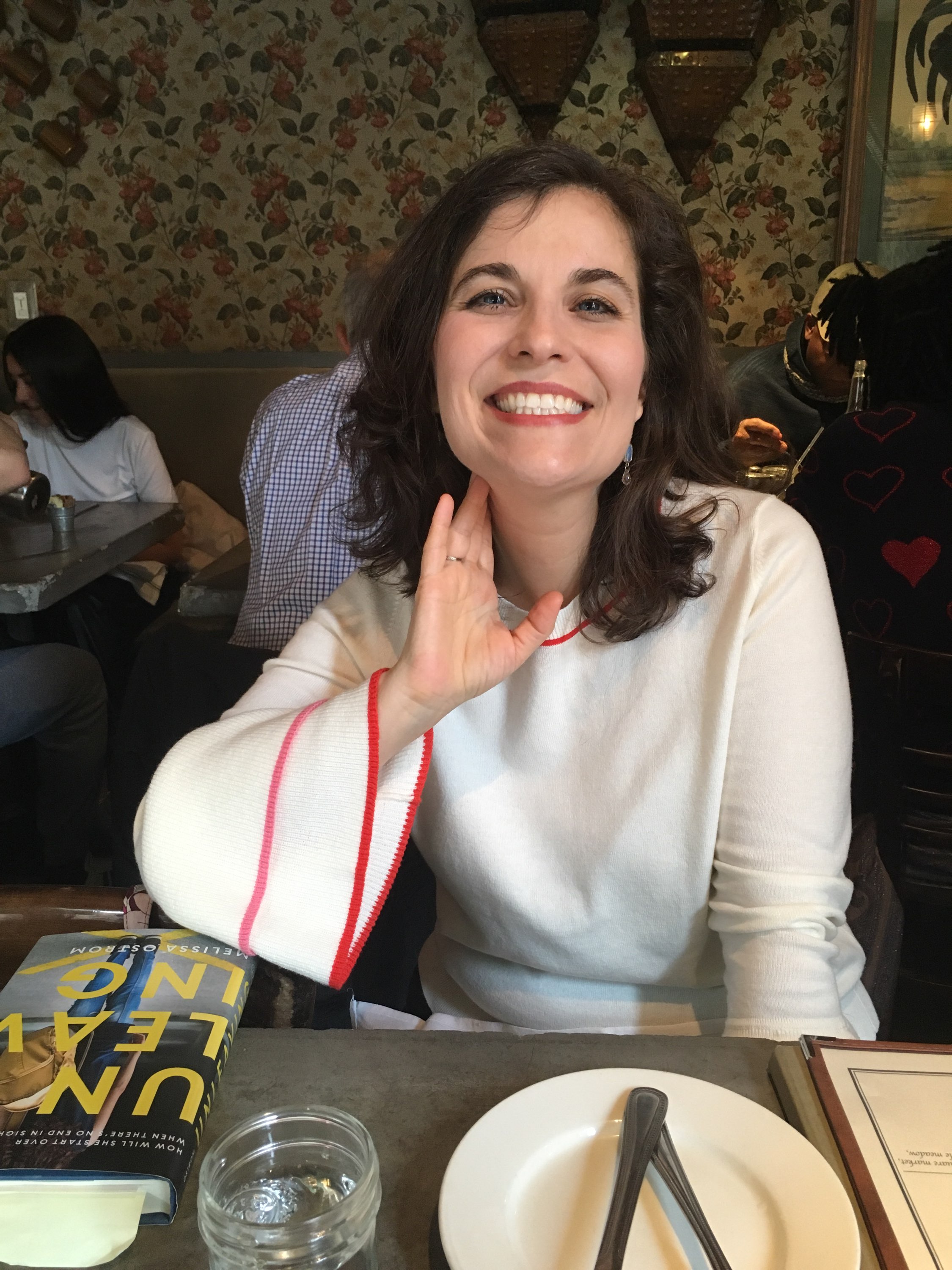

Melissa Ostrom is the author of The Beloved Wild (Feiwel & Friends, 2018), a Junior Library Guild book and an Amelia Bloomer Award selection, and Unleaving (Feiwel & Friends, 2019). Her stories have appeared in many journals and been selected for Best Small Fictions 2019 and 2021, Best Microfiction 2020 and 2021, and Wigleaf Top 50 2022. She lives with her husband, children, and dog Mocha in Holley, New York. Learn more at www.melissaostrom.com or find her on Twitter or Bluesky @melostrom.
My Son Asks About Death, a Diptych by Bethany Jarmul

Mommy, when someone turns 100, they die, right?

If only it worked that way. If only each of us, on the eve of our century, climbed into bed for the last time, having filled our bellies with chocolate cake and red wine, gifted our gold earrings and dog-eared books, dolled out pithy wisdoms and Werther’s candies, hugged the necks of everyone we loved, kissed our children’s cheeks, felt the rain on our wrinkles, watched the sun rise and the sun set, planted an apple tree or three. One day, you’ll learn all the ways people die young. One day, I’ll have to tell you.

Mommy, when you die do I get a new mom?

If the sun burns out, the world freezes in darkness. If gravity ceases, everyone and everything not-rooted releases. If all water disappears, nothing can replace it. “You only get one mom,” I say. Which is both true and not true. Someone else could kiss your sticky cheeks, sing “Hush Little Baby,” make you pancakes and honey, could teach you how to ride your blue bike, how to tie your bunny-eared shoelaces, how to spell G-O-N-E. You might even call this person Mom.


Bethany Jarmul is an Appalachian writer and poet. She’s the author of two chapbooks, including a mini-memoir Take Me Home from Belle Point Press. Her debut poetry collection Lightning Is a Mother is forthcoming with ELJ Editions in 2025. Her work has been published in many magazines including Rattle, Brevity, Salamander, and The Ex-Puritan. Her writing was selected for Best Spiritual Literature 2023 and Best Small Fictions 2024, and has been nominated for the Pushcart Prize, The Best of the Net, Best Microfiction, and Wigleaf Top 50. Connect with her at bethanyjarmul.com or on social media: @BethanyJarmul.
The Land Between by Maggie Maize

A few miles up from the creek mouth, untouched by the ocean’s salty backwash, an expanse of farmland sprawled between two hills, hills that Samantha Kane liked to call mountains but Daddy said didn’t quite qualify. He claimed to know land. Nothing made him happier than perfectly flat dirt and perfectly straight rows. He said the smallest divot led to uneven watering, which led to unevenly ruined crops and an unevenly clothed family.

Swollen and hollowed land reminded Sam of the bulges and dips on bodies. And if humans and critters have them, why couldn’t the ground? Although, one time she did see a broken arm under the monkey bars, loosely attached to Mike’s body. That was unpleasant, and an oily pain heated her spine whenever she came across an animal carcass on her way out to the roadside chalkboard.

Sam agreed her mountains were hills only in the right light—only when the gaps between the trunk bases revealed patches of sky way down the horizon line. And when that happened, it was like digging in the creek mud and seeing the sediment layers, like pulling the cooked meat out of the fridge and playing with the separated fat. Of course, the trees didn’t drip to the earth like the stuff warmed by her hands. No, the trees stuck out of the hill like the peg people jammed into The Game of Life’s minivans.

Sam played Life on the well-splintered table during her summertime shifts at the farmstand. Occasionally, Tuckins (a sucker for the farm’s plums) ducked in for a spin. He played the red minivan. All the other colors were Sam’s.

“I don’t know about you, Tuckins, but one life doesn’t seem like enough.” She married in one, stayed single in another; but she always left the farm.

She liked that Tuckins didn’t spew platitudes about making the most of her real life. Tuckins simply smiled, said, “I know, kiddo,” spun the wheel, and watched it go round. Then he moved his red minivan piece, took the fake money from his wallet, paid his college tuition, took the real money from his wallet, paid for the plums, watched Sam take her turn, exchanged condolences about their dwindling fortunes, and went on his way.

It wasn’t strictly part of her farmstand duties, but Sam liked examining the book covers people donated. She searched for pretty fonts and snippets of bare skin. Reading more than three pages of grown-up books felt like splashing into the creek’s belly after heavy rains. The words funneled her head full of sand, and spinning the Life wheel between chores let out only a few granules at a time. Sam didn’t expect anyone to understand this. The creek did, though.

Lying there, greeting the millions of molecules sweeping by, Sam wondered if they wrestled for the middle of the stream the way people at school tunneled for the center of the lunch line. Did they know the outliers were likelier to be sloughed toward the back and left behind? The water trying to cut corners tripped on the rocks and lay pinned under the sun, waiting for evaporation to take them to their next form. Sam wanted to ask the dying molecules if they were bitter. But what if they weren’t and spent their last moments pondering an emotion they hadn’t yet experienced? So Sam stayed there as long as she could, waving to the perceived lucky ones and keeping her thoughts from the lonesome.

Soon she had to crawl into the water. There wasn’t even room in her word-filled head to feel guilty for interfering in the molecules’ fate, not when they weaseled into her ears, extracted the words, and washed them away. Would the words scatter and float up into the sky out of order? Did the ones carrying her thoughts travel slower? Would someone downriver catch them? Would they run ashore? Or would they make it to the ocean? Infused water was all the rage at school last year. Mineral-infused. Fruit-infused. Natural Flavor-infused. How many of these held more than expected? Had people upstream spilled in their knowledge or maybe the bug-killing juices Daddy bemoaned? How much had soaked into the ground? Into her skin?

Sam pulled her head out and listened to the last question dribble out of her ears. Was absorbing into a farm girl’s shirt an honorable end? The water trickling down her face seemed to say yes.


Maggie Maize is a writer who enjoys spinning compost and whispering to her seedlings. She earned a BFA in writing from Savannah College of Art and Design and a Novel Writing Certificate from Stanford Continuing Studies. Her writing has appeared in Post Road Magazine, Funicular Magazine, and more.

Can’t Have My Ghost by Jacqueline Parker

I hear my mother’s voice as I open the kitchen cabinet to take down her favorite mug. If it could talk it might sound like her, with the high pitch of know-it-all confidence and a singsong lilt on words she wants to emphasize like Jeannine, coupons, and your father. The mug, of course, doesn’t talk and my mother is gone so all I’m left with is the Red M’n’M character smirking back at me from the curve of the cup, its black comma eyebrows arched in mockery. I’m back, just like she predicted.

I make coffee and eye the cars pulling up on the lawn. Locusts, all of them. My mom used to do it, too—scour the newspapers for sales and patrol neighborhoods at daybreak, coast onto the browning lawns of elderly couples cleaning out their garages. She’d often take me with her, teasing the mystery of discovery, as if someone’s discarded Rubik’s cube could unlock untold possibilities. She loved the thrill of giving new life to someone’s forgotten objects and preached the importance of a circular economy long before it became a corporate catchphrase. Why buy a new dress when you can get this muumuu for $2? I’ve got a McCall’s pattern that will make this look brand new! Never mind that the dusty pink nighty was worn by someone for half her married life.

Her frugality was later abandoned in favor of late-night flash sales on QVC after one too many drinks and sleepless nights after my father died. This, unfortunately, saddled me with a smattering of saucer-eyed porcelain dolls, souvenir teaspoons from 39 states, DVDs from Wal-Mart’s bargain bin, and celebrity-hawked cookware still in the manufacturer’s box.

It took me a week to dig through the debris she left. And much of what was hers, was surely someone else’s in a former life. When I finished sifting, I tacked signs up and down the town: Estate Sale. Yard Sale. Garage and Junk Sale. Things My Mom Left Behind Sale. Please Take this Shit Sale. Who Needs Two Salad Spinners? Sale.

The buzzing intensifies. When I’m ready, I prop open the screen door with an empty planter and invite the swarm inside.

Mmmm, smells like freshly brewed coffee, a woman says, nodding at the mug in my hand. I pour myself a cup. I don’t offer any.

A teenager pokes her head in the front door, cautious and skeptical. Mom’s not haunting this place, if that’s what you’re afraid of, I say. I take a sip and wink at Red. At least, I don’t think so.

It’s a lie, and I sense that the kid knows it as she wanders down the hallway that leads to my old room. My mother’s ghost everywhere. Evidence of her lives in the misaligned panels of wallpaper she pasted up at two in the morning. She’s in the chalky hole in the drywall behind my bedroom door. In the tile grout, in the dust dunes gathering on the fan blades, in every patchy spot of lawn where she tried and failed to grow.

And while the pores of her house are excavated by careless archaeologists, I poke around my mother’s hiding places for liquor. I know there’s a bottle around here somewhere and now’s about the time she’d replace cream and sugar for Jack.

How much for this? Someone asks. He’s a big guy with a bushy beard and a tattoo of Daffy Duck on his bicep. He might have been one of my mother’s boyfriends, but then again he might be no one. One of my grandma’s afghans is slung over his shoulder like a half-worn cape and he’s carrying a lamp under his arm. In his free hand is the mug.

That’s not for sale, I say too quickly. Warm panic inches up my throat and I really want the man to put the cup down. I’m afraid his grip will break it. I can even see Red’s face melt, his swooshed brows furrowing in fear. There’s coffee in it, I explain. It’s being used.

He looks down into the mug. No there isn’t.

Well, there will be.

Okay, he says slowly. How about all this then?

I wonder if I look crazed; I feel it. He shouldn’t have touched the mug and now his very presence inside my mother’s house makes me want to slam the doors and scream into a pillow.

Ten bucks.

That’s a steal. He hands me cash and lumbers off, looking back once. To me or the mug, I’m not certain.

By mid-afternoon the house is picked clean. When everyone’s left, I lock the door and turn on another pot of joe. As it brews, I sit on the kitchen counter and thump my heels into the cabinets like I did when I was a kid stirring a pot of easy mac while my mom smoked Winstons out the window.

I think of what I might tell her about today. She’d relish in knowing her home was a bargain bin Antiques Roadshow. A little tap-tap on her cigarette in the ashtray and she’d tip her head back to laugh at how someone tried to sneak off with the fuzzy blue toilet seat cover. There’d be a smile knowing I managed twenty dollars for her ancient washer. Held together on duct tape and dreams, baby. She’d scoff at the three offers on the house, all declined, and tell me I should have accepted. I would have given it away for nothing—maybe I should have—but I’m not ready yet.

I collected pennies on the dollar and watched midnight dance parties and screaming matches, movie marathons and family secrets filter out in the hands of strangers. They don’t even know that a layer of her now lives with them. In every item, a stratum of memory.

All I’ve got left of her is this stupid cartoon coffee cup and an empty house, and it still feels like it’s too much.


Jacqueline Parker is a writer/editor based in Charlotte, NC. Her fiction often explores loss in its many forms, but occasionally she writes something funny. She’s an Associate Flash Editor at JMWW and you can find some of her work in Funicular, Flash Fiction Online, Blue Earth Review, and elsewhere. She’s currently working on a collection of short stories and flash exploring the feminine wild. Read her work at www.jacqueline-parker.com or connect on social @onmytangent.