Music Lessons by Andrew Gray Siegrist

The neighbor boys carried the piano out into the rain. They’d taken the French doors off their hinges and left them leaning against the house. We watched them set the piano in the grass as thunder rolled and the cluttered gutters spilled over the eaves.

“It looks like something is happening,” you said.

“We should put on our boots,” I said.

It was still afternoon but already dark. Storm clouds were heavy and low. I could smell the lotion you left open on the dresser.

“Eucalyptus,” I said.

“No,” you said dipping a finger and touching it to my neck. “Japanese Cypress.”

“We should dress,” I said.

“Or turn off the light,” you said.

We stayed at the window and watched the neighbor boys carry the doors back into their jambs. They were home from college. They held the doors as if they weighed nothing at all.

“I remember when you were young,” you said.

“I’m not old yet,” I said.

“Not old,” you said. “But I remember when you were young.”

You raised the window and we listened to the sound of the rain in the leaves. Water puddled on the floor. Lightning lit and the neighbor boys shut the French doors. A lamp was on their parent’s bedroom. The curtain half closed.

You fell asleep in that room once. On the couch at the foot of the bed. You called it a davenport. A term your father used, you said. We were at a dinner party a few days after Christmas. The neighbor boys were children then. You drank too much wine and smoked a joint with the doctor’s wife in the basement. I found you asleep an hour later on the davenport in their bedroom. You wear wearing a string of the wife’s pearls. There was a pile of coats on the bed.

“I remember waking up there,” you said. “You had taken off your shoes. I thought that was strange.”

“The doctor wanted to look at my feet,” I said. “I’d lost you. I was telling the story about the sewing needle I stepped on as a child. The doctor didn’t believe it was still in my foot. He knelt down in front of everyone and untied my laces. It was late in the evening.”

“After he’d played the piano,” you said.

“Yes. The song you taught him,” I said. “After I lost you.”

“I wasn’t lost,” you said. “I needed to rest.”

In the yard the piano sat quiet in the rain. You went to the bathroom and turned on the shower. When you came back you were wrapped in a towel and the storm had begun to calm.

“How long will they leave it out there?” you said. “How long until it’s ruined?”

“I’m waiting for them to carry the doctor out and leave him there beside it,” I said.

“His wife must be behind all this,” you said. “She told me once to pull all her roses when she died,” you said.

“You didn’t,” I said.

“No,” you said. “I sent over a casserole.”

I watched you dress. You dropped the towel on the floor beneath the window and mopped up the rain with your foot.

“I’m going over there,” you said.

“Don’t,” I said.

“He can’t see the yard from his bed,” you said.

I imagined those pearl you wore that night, years ago. Where they were now. I took the towel to the bathroom and hung it to dry. The mirror was still fogged. I could hear your footsteps down the stairs. The backdoor opened. The screen slapped shut. When I came to the window you were crossing the yard. You stopped and looked back. You were wearing a pair of my boots. I touched the glass with the palm of my hand. You waved.

What I never told you about that night after the doctor took off my shoes, was that he touched the sole of my foot where the skin had grown over the needle and said, “Your wife is a hell of a teacher.”

You turned and walked through the rain. The neighbor boys hadn’t brought out the piano bench so you stood and raised the fallboard. You began to play. The rain was quiet and I could hear the notes. I looked up at the doctor’s window. I waited for the curtains to close or the light to turn off. I recognized the song. I touched my neck where you’d left the scent of cypress. The neighbor boys opened the doors and stood watching you. Their father was somewhere in the house. The roses in the garden were still in bloom.
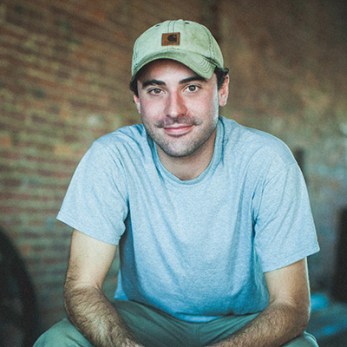

andrew_editedAndrew Siegrist is a graduate of the Creative Writing Workshop at the University of New Orleans. His debut collection of stories, We Imagined It Was Rain, was awarded the C. Michael Curtis Short Story Book Prize and published by Hub City Press in 2021. His work has appeared or is forthcoming in Wigleaf, trampset, Juked, the Mississippi Review, Baltimore Review, Arts & Letters, Greensboro Review, Pembroke Magazine, South Carolina Review, Bat City Review, and elsewhere. He lives with his wife and two daughters in Nashville, Tennessee.

a tale of a man and a dog who left to an unreachable place by I Echo

“To call you my friend? My wife? My love, my editor, my pet? I don’t know. Already you move hazy through my life & then out of it again.” – Essay on Crying in Public by Cameron Awkward-Rich

some friends have boyfriends some friends are pregnant some friends are abroad and play it like they’re at the end of a road near extinction let us say i once had a dog i never told my sister certainly not my brother i cannot remember if i loved my dog all i remember is life was as a scaffold to sweet bliss i was the coupler and the dog was the brace this is a difficult thing to say but it isn’t a difficult metaphor to use we needed each other weeks passed my lover i mean my friend i mean my dog would leave bowls full of stale meals in my wake which is to confess unfed by my hand it grew still i wondered why i asked why expecting my dog to talk back to me like waiting for a door at the fore of a solid brick wall if ever you had your echo return to you you probably figured how this tale would end so allow me skip it would you scratch that i know how the illusion of life can joyfully strain a thing suffice to say weeks passed my dog died which is to say it entered an unreachable place i didn’t shed a tear but i felt a tear in my chest like a piece of fine cloth splitting its weaves yes i was distressed like a bird without wings but who could i tell it is a wretched thing to serve an end without a beginning like waking up one morning with so many happy things that do not belong in your head


20231025_113155_00002 (2)

I Echo is a Ghanaian-Nigerian writer on a neverending search of self. He is confident in one thing: He would like to explore the world, realise new cultures, create new conversations and hopefully save the world by saving himself. He tweets as @AyeEcho

A Girl and a Tree and a Rocket by Pauline Holdsworth

Mara arrived in January, as regal as a beech tree, and planted herself in the yellow house across the street. From my bedroom window, I watched her skip rope like she was training for a NASA mission. She was like that from the start: formidable. By the first week she had made friends with almost everybody but me.

I still wore corduroy skirts and tall socks embroidered with apples. I was picked last for kickball. I had straight Bs. “You have such promise,” my teachers said. All around me people were blossoming, but any flowers I could muster yielded only hard, sour fruit. “Crabapple,” my mother called me affectionately, instead of honey, and I hated how well it fit.

In February, our science teacher paired Mara and me for a project. She thought Mara would rub off on me. Make me braver, maybe, less prone to sputter in class. But every time Mara got another answer right, anger fermented in my chest. When she raised her hand, the skin on her forearm was so thin I could see the blood moving. I dismantled a paper clip beneath my desk and daydreamed about etching my initials onto her skin.

I ran hot in those days: my temperature, my temper. I sweated in T-shirts on days Mara wore thick wool sweaters. She shed fibers every time she moved. Her scratchy sleeves rubbed against my skin. When I scooted away from her, her gray eyes pooled. The next day, her smile was even wider. Her niceness was one more thing I coveted but couldn’t reach.

“You should walk to school with her,” Mom said. “She’s new. She could use a friend.”

“She has more friends than I do.”

Mom laughed and told me that was all the more reason to be nice to her. Still, I scuttled away when she approached me in the hall. I side-stepped her smiles.

But something was changing. The trees in front of our houses draped their arms around each others’ shoulders. In March, we learned about inosculation: what happened when different trees chafed against each other. Their bark wore thin. Their cells merged. The trees grew conjoined. “Husband and wife trees,” our teacher called them. Mara shifted beside me, and I felt flayed. “That’s what we should do our project about,” she whispered.

In April she started waiting in front of my house in the mornings, underneath the kissing, sighing trees. She walked beside me in silence. It’s OK, I told myself. We’re not friends. We’re something else. Neighbors. At the end of the week, she held out her hand, her face serious. “Friends?” she said. I took her hand.

We started studying together, stretched out in her bed or mine. She swapped the story of her parents’ divorce for the location of my brother’s weed stash. We smoked by my open window, giggling against each other’s shoulders. We collapsed in my bed, our arms indistinguishable. We dared each other to become a dolphin, a boat, a rocket, a centipede. We squeezed our eyes shut and contorted our bodies into new shapes. With my eyes closed and hers on me I could be anything. Steel, bark, honey.

From then on, we linked arms in the hallway and split our sentences so we could share them. We made a new kind of fruit: bristly, nutty apples. “We’re going to be this close forever,” I told her. I hadn’t been the kind of person who thought about forever before, but now I was. She rolled her eyes at me, and I rubbed my shoulder against hers. “I mean it,” I swore.

I meant it the day she painted GO on my exposed stomach with pasty blue paint before her sister’s swim meet, and my skin prickled even in the places she didn’t touch. I meant it when we started high school and I memorized the 63 steps between her locker and mine. I meant it right up until the day in 10th grade when we were tangled in her bed, tickling each other senseless, and the joke in her eyes softened. I started to feel light-headed, exuberant, afraid. Her lips against mine were tentative, as if she were the one who didn’t know what to do.

I flinched. She didn’t. I started dating boys. She shaved the left side of her head and brought a girl to prom. I applied for college out-of-state. She stayed and made our town change around her. I told myself I’d never had her certainty anyway.

Still, I tracked her life on Facebook. I marveled at the dizzying shapes of her new friends’ hair. I tried to squelch my jealousy, that old prickly anger at how easily she reached for what I lacked. I closed my laptop and splashed cold water on my face. In the mirror my hair was flat, my eyes sad. Turning away was a habit. It was the only thing I was better at than her.

Then I stopped. I closed my eyes and tried to believe that I could remake myself the way she’d once reshaped me. That I could be anything: a girl, a tree, a rocket, all at the same time. My fingertips prickled, and I tasted apple-crisp beechnuts on my tongue. I turned back to the mirror and searched my eyes for the first flicker of something new.


Pauline_Holdsworth_for_LB

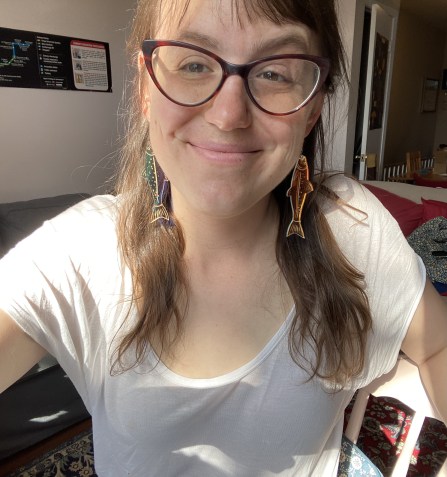
Pauline Holdsworth is a writer and public radio producer who grew up in central Pennsylvania and now lives in Toronto, Canada. Her fiction has appeared or is forthcoming in Bat City Review, Necessary Fiction, Pithead Chapel, JMWW, and elsewhere. Her work has been shortlisted for The Masters Review 2021 Summer Short Story Award for New Writers and longlisted for the Wigleaf Top 50.