In these last dregs of winter, day and night hold each other close. Dusk lasts for hours as light brushes cool against darkness, and sunrise clings to the last sprinkling of stars. The cold brings with it its own silence, a silence that defies even the wind, raw and damp and searching, sinking so deep into the landscape that it ceases to shiver. Sometimes it’s impossible to believe that there’s anything other than this heavy quiet, but when she looks out to the lake, she hears things. The prickle of ice against water. The hushed lick of water against rushes. The glide of feathers.
The swans always come at this time of year, when it seems impossible that winter will ever end. Only then will she see them, slow white streaks against the bone-grey of the sky. They fly low and land on the lake, its water still pewter, its breath still mist that curls and condenses in the chill. Two of them, the same pair every year, defying her expectation that they will have forgotten her.
Her mother’s shadow also flies low. Unmoored by thin, barely-there days, it stretches over the kitchen and out into the garden, across the living room and up the stairs. It quivers in the wind but never disintegrates, its edges bolstered by the wan sunlight that trickles in through the windows and pools on the floors. Her mother’s shadow, a body swimming. She’s tried telling her mother about the swans, but her mother and the shadow both tell her that she’s making it up. How can she be, how can her mother not have seen them? But her mother will say that she reads too much and has too vivid an imagination, and the shadow will nod in agreement and the whole house will ripple with it. Look out of the window, her mother will say. There’s not even a lake.
But there is a lake, and she’s seen them building their nest in a clump of reeds, the same spot every year. She can hear that too. The thick rustle of twig against twig, a huge mound of them matted together until nothing can get in or out. She’s seen them with the eggs. How protective they are, how they nurture them through the spring storms that are fiercer than winter. What would it be like, to be held so safely? She doesn’t know. She doesn’t think her mother has ever held her at all.
There are lots of things her mother doesn’t seem to do or to see, things that glimmer at the edges of vision like dust motes caught in a strand of light. Things that are just as easy as dust for her mother to sweep away. She’s given up asking her mother to look properly. Can’t you see them? she used to say, pointing to the lake and the swans. You must be able to see them, holding out her arm, her cheek, her heart, still bruised with her mother’s fingers even after so many years, still beating like the steady drip of water from a tap. Drip, drip. Her own body, finally thawing into spring. But her mother says it’s still winter. Her mother says that the bruises aren’t bruises at all. How could they be? she’ll ask, and the shadow will shake its head in puzzlement and the foundations of the house will feel like they’re shifting.
But each year there’s one less egg. Each year there is one less cygnet gliding in their wake. There is a gap in the nest that swells larger each year, but it’s not a quiet gap. There, too, she can hear things. A feather-touch of body against air. A whispering that she thinks must come from the swans. Each year it draws her closer, and last year, she knows, there was only one egg. This year there are none, and the noises from the nest are louder than ever.
She makes her way out to the lake. There is blue in the sky today. There is blue in the water too, pale shimmers of it that drift between the greys. She walks along the path that slides between ice and mud, and she feels her mother’s eyes on her back, feels the lingering fingers of her mother’s shadow. She ignores them. Out here, she is no longer her mother’s daughter. She is swan-call, lake-rustle, a soft feathery shade of grey, and she can hear the singing as she wades through the reeds, water falling away from her body and her feet webbing against the silt. She curls up inside the nest, cocooned suddenly from everything except the sky. The feathers that cover her are breast-warm and damp. She forgets her mother, forgets the bruises, forgets that the lake isn’t supposed to be there at all.
She closes her eyes. The nest, now, is silent.
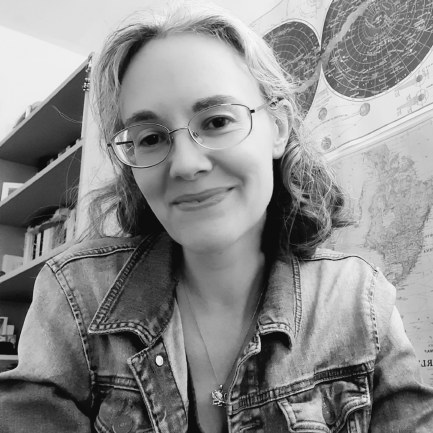
Elodie Barnes is a writer and editor. Her writing is born at the edges
of nature, memory, trauma and the body, and is published regularly in
online and print journals including the Best Small Fictions anthology of
2022. Find her online at elodierosebarnes.weebly.com.
 Lost Balloon